
Live Blackjack Online Casinos in the UK: What to Check
 Available in GB
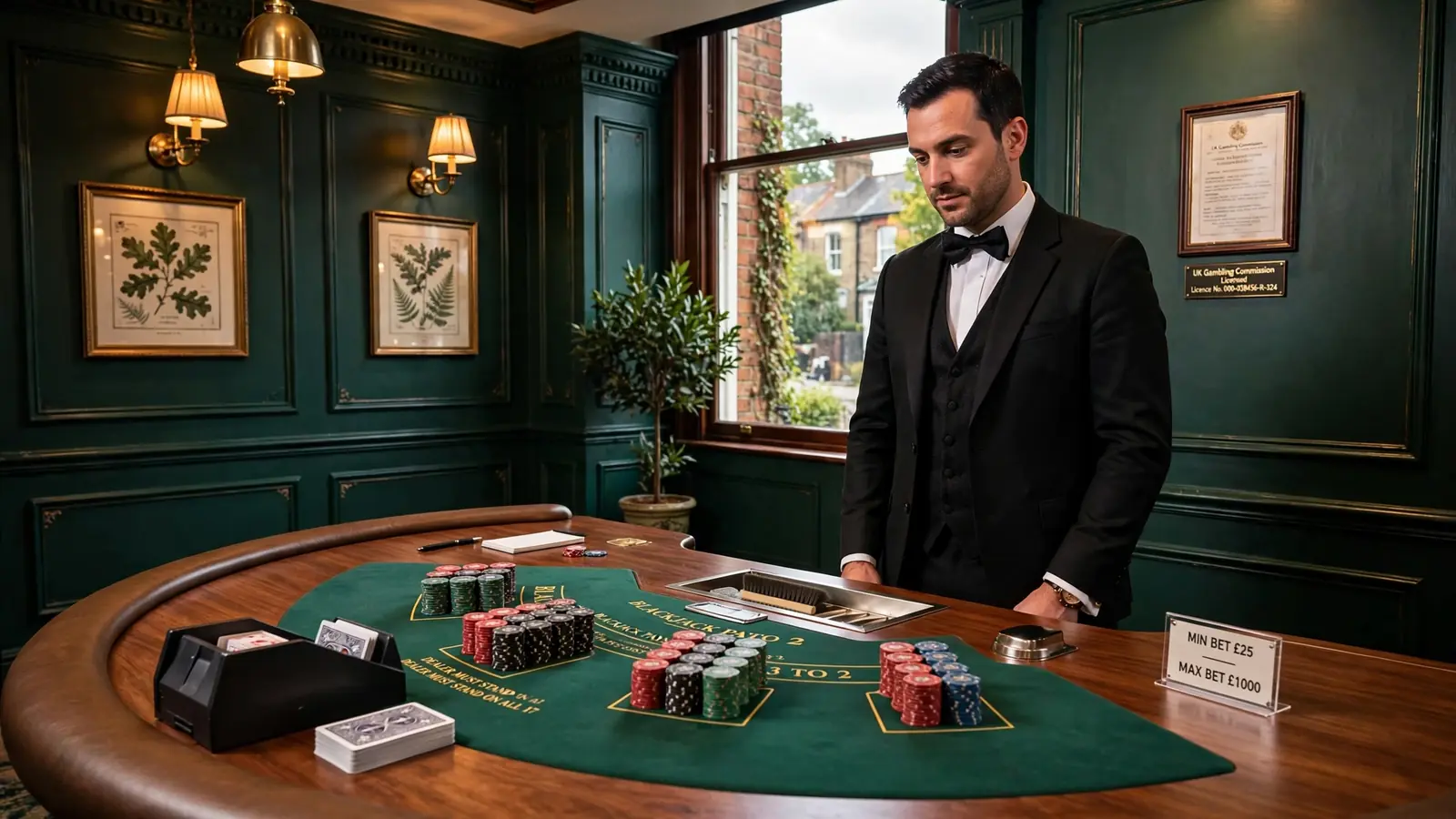
Table of Contents
A practical overview of UK licensing checks, live blackjack formats, account payments, strategy limits and the terms that affect play.
Checking a UK Casino Before Opening an Account
A casino’s branding is not evidence that it is authorised to accept customers in Great Britain. A polished site, familiar-sounding name or blackjack-themed presentation says nothing by itself about the business responsible for the gambling. The relevant check is whether the operator holds the licence required to serve the market, and whether the details on the public register correspond to the site being considered.
The Gambling Commission requires remote operators serving consumers in Great Britain to hold the relevant licence. That requirement applies to the operator, not merely to a game provider, payment brand or group name mentioned on a page. A casino can display the name of a recognised company without making clear which legal business operates the site. The name on the register therefore needs to be connected to the actual service, rather than treated as a reassuring logo.
A sensible first check is to identify the operating business from the casino’s terms or other account documentation, then compare that identity with the UK Gambling Commission’s public register. The regulator’s register is available through its official website. A result should be assessed against the specific brand and web address, not just a similar company name. A business with a familiar name is not automatically the operator of every site using that name, and a small difference in a web address can point to a different service.
Match the register to the site
The register check is an identity check as much as a licensing check. The operator named on the site should be traceable to the relevant entry, and the entry should make sense in relation to the brand or domain through which the account would be opened. If the relationship is unclear, the branding does not resolve it. The unresolved detail is the point to pause on.
Live Casino Lightning Roulette in the UK: What to Check
A specialist review reports that a search of the public Gambling Commission register dated 26 September 2026 did not identify a LuckyPays entry under that brand or its stated domain, including luckypays.io. That is a report about a register check at a particular date, not a permanent description of the register or a substitute for checking it directly. It also does not establish that every site with a similar name has the same operator. The practical lesson is narrower: a brand claim should not be accepted as proof of a licence when the corresponding operator or domain cannot be matched on the regulator’s register.
A licence number printed in a footer is not, by itself, confirmation. It should be checked against the public register before funds are deposited. If the number belongs to another business, or the listed operator cannot be linked to the casino, the apparent detail has not answered the question. A verifiable match matters more than a badge or a statement that the casino is “UK friendly”.
What the check can and cannot establish
A matching register entry supports the conclusion that the identified business holds a relevant licence. It does not turn every claim on the casino’s website into a regulator-approved statement, nor does it establish that a particular blackjack table suits a player. Operator credentials and the quality of a casino’s offer are separate assessments.
The distinction also matters when several names appear on a site. A software supplier may provide games, while a separate company runs the casino and accepts the customer’s account. The presence of a recognised provider does not establish that the operator itself holds the required licence. The register check must lead back to the business responsible for the gambling service.
Where the register search produces no clear match, the gap should not be filled with assumptions based on advertising, customer reviews or a familiar visual identity. Nor should a similar company entry be treated as interchangeable without evidence connecting it to the site. A business may change its details, so a result should be read as a check made at a given point rather than as a guarantee about every future version of a website. If the operator’s identity remains unclear, there is no sound basis for treating the branding as verification.
Do
- Identify the operating business from terms or account documentation
- Compare the identity with the UK Gambling Commission’s public register
- Verify that the licence number matches the actual operator
Don’t
- Accept polished branding as evidence of authorization
- Trust a licence number printed in the footer without verification
- Assume a familiar company name automatically means it is the operator
This is particularly relevant when comparing blackjack casinos in the UK: the word “UK” in a page title or promotional message does not establish that the operator is authorised to serve Great Britain. The question is not whether the site appears local, but whether its operating business can be matched to the relevant Commission entry. That check should come before account decisions, not after a balance has been funded.
Even where the operator’s credentials appear to match, gambling remains a financial risk. Only gamble what can be afforded to lose. A licence check establishes a regulatory point about the operator; it does not make a wager safe or guarantee a return.
What Makes a Blackjack Casino a Better Fit
A suitable Blackjack casino is not necessarily the one with the largest lobby or the most prominent headline offer. The useful comparison is between the conditions attached to play: what is available, what must be accepted to access it, and which controls remain available once an account is open. A claim to be the best Blackjack casino UK players can use has little value unless those conditions can be checked before money is committed.
Compare access, not advertising
Start with the route from the casino homepage to a playable Blackjack table. Is the game clearly identified, and are its rules and table conditions available before a wager is placed? Can the relevant information be read without relying on a promotional banner or a support conversation? These are practical questions, not cosmetic ones. If key conditions appear only after several clicks, comparing one casino with another becomes harder because the actual offer is less transparent.
Live Baccarat Online Casino UK: Licensing Guide
Access conditions also include account eligibility, geographic restrictions and any requirements attached to particular games or promotions. These should be stated plainly. A game displayed in a lobby is not, by itself, proof that it is available to every account or under every condition. The distinction matters when assessing an online casino for Blackjack: availability is part of the offer, while the image used to advertise it is not.
The comparison should also record whether the casino explains how its account controls work. Remote operators must prompt new customers to set a financial limit before the first deposit and provide accessible account-level limit controls. A clear process makes the restriction visible as an operating condition, rather than leaving it buried among general account information. The value is practical: the player can see what can be set and where it can later be reviewed or changed, subject to the operator’s terms.
Read the terms as operating costs
Terms are not just a legal appendix. They determine how much flexibility an account has and which actions may be restricted. Check whether the casino explains account closures, withdrawal conditions, inactive-account treatment and restrictions on using particular payment methods. The relevant comparison is not which site uses the friendliest wording, but whether the condition is specific enough to understand before it affects the account.
A bonus can complicate the calculation, so it should be assessed separately from the underlying Blackjack offer. Eligibility rules, qualifying games, expiry conditions and withdrawal restrictions can change the value of an advertised benefit. The headline amount is not the final amount available to withdraw; it is only one input to the terms. A casino with a simpler base offer may be a better fit than one whose apparent advantage depends on conditions that do not suit the intended use.
Attention: A bonus is a separate arrangement with its own conditions and should not be treated as a feature of the Blackjack game itself.
This distinction also prevents a common comparison error: treating a promotion as a feature of the game itself. Blackjack remains the product being assessed; the bonus is a separate arrangement with its own conditions. If those conditions are unclear, the apparent advantage cannot be priced reliably. There is no useful calculation when the inputs are hidden.
Check the account controls
Account tools are part of the casino’s overall suitability, not an optional extra. Compare how readily financial limits can be found, whether the account area gives a clear view of those settings, and whether the operator explains the process for making changes. A control that exists but is difficult to locate is less useful in practice than one presented clearly alongside account information.
The same comparison applies to time away from play and self-exclusion options. The interface should explain what the available controls do and how they affect access. This is not a promise that any control will produce a particular result; it is a way to judge whether the account arrangement makes its boundaries legible. If the terms are difficult to find before opening an account, that is a cost in uncertainty.
Payment conditions also affect fit, though they should not be confused with the Blackjack offer. UK-licensed casinos cannot accept credit cards for gambling, and operators cannot accept wallet payments where the wallet permits credit-card funds to be used for gambling. A casino’s payment information should make its restrictions clear. These limits can affect how an account is funded, but they do not make one Blackjack table better than another.
Keno Online Casinos in the UK: Draws and Payouts
Make a like-for-like comparison
A useful comparison keeps the same questions for each casino: are the game’s terms accessible, are account restrictions explained, can financial controls be found, and are payment conditions stated clearly? Record the answers before weighing presentation or promotional language. Otherwise, a polished lobby can appear to offer more when it has only made the same conditions less visible.
The best online casino for Blackjack is therefore a matter of fit, not a universal ranking. One account may suit someone who values clear controls and uncomplicated terms; another may not, even if its advertising is louder. The final comparison should be based on the conditions that can actually be read, not assumptions about what a casino probably allows.
Blackjack involves financial risk, and an account’s controls do not remove it. Only gamble what can be afforded to lose.
Top online casinos in the UK
- NightWinBonus: £900 + 400 free spins · Payout speed: 1-3 business days
- SpinFormulaBonus: 550% Up To £15,000 + 550 FS · Payout speed: 1-3 business days
- ZombillionBonus: Welcome Pack 250% up to £4000 + 200 FS · Payout speed: 1-3 business days
- JetsetspinsBonus: 200% Bonus + 100 Free Spins + Free Royal Wheel · Payout speed: 1-3 business days
- ChanzeBonus: Slots Welcome Bonus #1 200% up to €500 · Payout speed: 1-3 business days
- EvoSpinBonus: 125% up to €2500 + 125 Free Spins · Payout speed: 1-3 business days
Live Dealers, Tables and the Games on Offer
A live-dealer Blackjack table combines a streamed game with an online interface for placing decisions. The dealer and physical table provide the visible centre of the game; the screen presents the controls and information needed to take part. This differs from an automated table game, where the round is presented through software rather than a live dealer feed.
A live-dealer Blackjack table uses a streamed game feed combined with an online interface, differing from automated table games that are presented through software.
The label “live” describes the format, not a guarantee that a particular table will be available whenever an account is open. A casino’s live lobby can contain several table listings, but their presence does not establish that each is running at the moment of inspection. Availability, table presentation and the available controls are separate details, so a listing should be read as an offer to access a format, not as a promise of continuous access.
Grosvenor provides a useful UK-market reference point. It first introduced its live casino games in 2013, with a selection that included Blackjack, Texas Hold’em and Roulette. That launch shows how a live casino can be presented as a broader table-game section rather than a single Blackjack product. It does not, by itself, establish what is currently offered at any particular table.
The choice of games and the way they are displayed can depend on the providers supplying the live content and the casino deciding how to arrange its lobby. A provider’s name identifies the source of a game; it does not settle whether the table suits a player’s preferences. The casino’s presentation still matters: clear labels, visible table information and a recognisable distinction between live and automated games make the selection easier to assess.
For a live dealer Blackjack casino, useful details are practical rather than decorative. The table listing should make clear that the game is live, identify the variant where relevant, and show the terms or limits attached to the table before play begins. The lobby should also make it possible to distinguish one table from another without relying on promotional wording. Where those details are difficult to locate, the presentation leaves important conditions to be discovered later.
Live Dream Catcher Casino in the UK: What to Check
A provider catalogue can contain more than card games, while an operator’s live section may select only part of that catalogue. As a result, two casinos using live content from the same provider need not display identical tables or organise them in the same way. Provider coverage is one part of the offer; the casino’s selection and how it is surfaced are the other parts. A broad catalogue is not automatically a useful one if the relevant table is hard to identify.
The same distinction applies to the phrase “online live dealer Blackjack.” It describes a way of presenting the game, not a single standard table or uniform experience. The dealer feed, interface and table information together determine what appears on screen, while the casino determines how that table sits within its wider live offer. Comparing those elements gives a more precise picture than counting game tiles alone.
A considered view of the live section therefore starts with what is actually displayed: whether Blackjack is clearly marked as live, what table details are available, and how easily it can be separated from other games. The number of listings is only a headline measure. The usable offer is the set of tables whose format and conditions can be understood before play.
How Casino Blackjack Works—and What Winning Depends On
Casino Blackjack is a contest between a player’s hand and the dealer’s hand. The aim is to finish with a hand closer to the game’s target than the dealer, without going over it. A hand that goes over the target loses, while a dealer hand that goes over may leave a player who stayed within it as the winner. If both finish on the same total, the result is generally a push: the original wager is returned rather than paid as a win. The table rules determine how these outcomes are settled.
Basic Blackjack outcomes
A push occurs if both the player and dealer finish on the same total, resulting in the original wager being returned. A player wins by finishing closer to the target than the dealer without going over, while going over the target results in an immediate loss.
At the start of a round, cards are dealt to the player and dealer. The player then chooses whether to take another card or keep the current hand. The dealer follows the table’s prescribed rules, and the hands are compared once the round ends. That structure is simple; the possible results are not. A hand can improve with another card, but it can also go over the limit. Keeping a hand avoids that particular risk, but does not prevent the dealer from finishing ahead.
Card values and the treatment of an ace matter to the total. An ace can count as a high or low value, depending on which gives the hand a viable total. A natural Blackjack is a starting hand made from an ace and a card worth ten; its settlement depends on the table’s stated rules. The label alone does not establish the payout. Before play, the rules for naturals, dealer outcomes, ties and available actions define what a winning result is worth.
That distinction separates winning a round from making money overall. A winning hand may return the original wager plus a payment, while a push returns the wager without a gain. A losing hand costs the wager. The exact payment for a win is a table condition, not something that can be assumed from the game’s name. Over repeated rounds, a player may win, lose or push in changing combinations; one favourable result does not settle the eventual balance.
For online casino Blackjack, the same basic comparison applies whether the cards are presented digitally or through a live table. The interface may make the choices visible, but it does not turn an uncertain result into a predictable one. The rules shown for the selected game remain important: different table conditions can change how particular hands are settled and what actions are available. The result of each round still depends on the cards dealt and the rules governing that table.
Fast payout online casinos in the UK: what to check
Winning Blackjack is therefore not a dependable way to produce income. Decisions affect which risks are taken during a hand, but they cannot guarantee the cards or the final result. A wager can be lost even when the player’s choice seems reasonable at the time. The practical measure is the amount at risk, not the confidence attached to a hand. Blackjack should be played only with money that can be afforded to lose.
Blackjack and Other Live Casino Game Formats
A casino’s game menu can be read as a range of formats rather than a single Blackjack product. Card games and wheel games ask for different kinds of attention, and the distinction matters when comparing what is available. Blackjack is one part of that range; Texas Hold’em and Roulette are useful points of comparison because they represent other familiar casino formats.
Grosvenor first introduced its live casino games in 2013, with card and casino games that included Blackjack, Texas Hold’em and Roulette. That historical example shows how a live casino offer can extend beyond one table-game category. It does not mean every operator carries the same selection or that a title is available in every version.
Card games and wheel games
Blackjack and Texas Hold’em both use cards, but they are separate casino games with different structures. Treating them as interchangeable because both appear under a card-games heading can make a menu look broader than it is. A useful comparison starts with the actual game names and format labels, then checks whether the selection contains the kind of play being sought.
Roulette provides a different contrast: it is a wheel game rather than a card game. This makes it a distinct option within a casino’s broader table-game range, not another version of Blackjack. A menu containing all three examples offers variety across categories, although the number of categories alone says little about the depth of choice within each one.
Fast Payout Online Casinos in the UK: What Claims Show
The term “live casino” can also cover several game types, not just live Blackjack. In practice, the relevant question is whether the games listed match the preferred format. Someone looking specifically for a casino Blackjack game should distinguish that from a general casino menu that happens to include other live titles. Someone comparing a wider selection can look for card and wheel games separately, rather than treating the total catalogue as one undifferentiated figure.
Reading a game menu
Game names are the clearest starting point. A menu may group titles by game type, provider or live-casino category, but categories are useful only when they lead to identifiable games. Blackjack, Texas Hold’em and Roulette are concrete examples; a broad label such as “table games” does not establish which of them is included.
The same caution applies to variety claims. A larger-looking menu is not automatically a closer fit: the relevant measure is whether it includes the preferred game formats, and whether those titles are actually accessible in the intended casino section. The available selection can differ between operators, so a historical example should not be read as a current catalogue for every UK casino.
Game choice does not change the financial uncertainty of gambling. A broader selection can provide alternatives, but it cannot turn any casino game into a dependable source of income. Play only with money that can be afforded to lose.
Deposits, Limits and Getting Started with Online Play
Starting online Blackjack involves more than choosing a table. Before funds can move into a gambling account, the operator must verify the customer’s age. Online gambling is legal in the UK for adults aged 18 and over when the operator holds a UK Gambling Commission licence. Until age checks are complete, depositing should not be available.
A separate control applies before a new customer’s first deposit: the operator must prompt them to set a financial limit. Account-level limit controls must also remain accessible, so the limit can be reviewed or changed through the account rather than treated as a one-off formality. These controls define how much money can be put at risk; they do not change the outcome of a Blackjack hand.
Funding an Account
- Complete age verification (18+)
- Set a mandatory financial limit
- Select an eligible payment method (no credit cards)
Payment restrictions narrow the available routes. UK-licensed casinos cannot accept credit cards for gambling. The restriction also covers credit-card funding routed through a money service business. A digital wallet is not a workaround where it allows credit-card funds to be used for gambling: operators cannot accept that wallet payment for this purpose.
The practical sequence is therefore age verification, a financial-limit prompt, then an eligible payment method. A payment option appearing on a cashier page does not override the rules on its underlying source of funds. Where a deposit is declined, checking whether the card or wallet is credit-funded is more useful than repeatedly submitting the same transaction.
For anyone planning to play Blackjack at an online casino, the deposit amount is only one part of the account decision. The relevant financial limit and the permitted payment route determine whether the account can be funded as intended. A free-play mode, if offered, should not be confused with a real-money deposit: the account and payment conditions for funded play still apply when money is added.
Crazy Time Live Casino Game in the UK
The same care applies after the first deposit. Limits should be visible in the account, and further deposits should remain within the amount set. A lower limit can restrict additional funding; it does not create a budget for losses or make play affordable. Gambling should be limited to money that can be lost without affecting essential costs.
Blackjack Strategy Without a Guaranteed Return
A blackjack strategy is a way to make decisions consistently, not a method for fixing the result of a hand. The distinction matters in an online casino: a decision can be deliberate and still be followed by an unfavourable outcome. No strategy turns a wager into a guaranteed return.
The useful starting point is to treat a strategy as a set of choices tied to the rules of the table. A rule or available option can change what a decision means, so a plan copied from another game may not fit the table being played. The table’s stated rules should be understood before any wager is placed; otherwise, the strategy may be based on assumptions that do not apply.
A practical approach is to separate three things that are easy to blur:
- The decision: the choice made during a hand.
- The stake: the amount put at risk.
- The outcome: what happens after the choice.
A favourable outcome does not prove that the decision was sound, just as a loss does not by itself prove that it was poor. Reviewing decisions independently of short-term results helps prevent a run of wins from being mistaken for evidence of a dependable system.
This is especially relevant to live blackjack. The dealer is shown in real time, but the presence of a live dealer does not remove chance or make an outcome predictable. A strategy can organise choices; it cannot control the cards. Claims that a particular approach guarantees profit, recovers losses or produces a certain return should therefore be treated as sales language, not as a calculation.
For a casino blackjack strategy to be usable, it needs to be clear enough to follow without changing direction after each result. That does not mean adopting a complicated system or increasing a wager to chase a loss. Changing stakes in response to emotion adds another decision and more money at risk; it does not convert uncertainty into certainty.
Financial Risk
No strategy can guarantee a return or remove the element of chance. Only gamble money that you can afford to lose.
The financial boundary remains separate from the playing plan. A strategy is not a reason to exceed it, and a losing session is not evidence that more wagering will repair the balance. Blackjack should involve only money that can be afforded to lose.
Live Blackjack in the UK: Licensing and Player Protections
Live blackjack is still remote gambling when the cards are dealt by a studio rather than generated by software. For customers in Great Britain, the location of the dealer or the equipment running the game does not remove the operator from the UK regulatory framework. The Gambling Commission regulates remote gambling offered to consumers in Great Britain, wherever the key equipment is situated. It is also the sole regulator for commercial gambling in Great Britain and regulates gambling activity in the United Kingdom, including online casinos.
The Commission’s licensing system separates business responsibility from individual roles. It issues operating licences to businesses and personal licences to individuals who perform relevant functions in Great Britain. A live table’s appearance, familiar branding or polished stream is not evidence of either licence. The legal position rests on the operator holding the appropriate authorisation, not on how convincingly its casino presents itself.
Before depositing, the licence number should be checked against the Gambling Commission’s public register. The entry needs to correspond to the business actually taking the account and offering the gambling, rather than merely to a game provider or a similarly named company. This is a practical identity check, not a verdict on whether the blackjack rules or table limits suit a particular player. A register search that does not match the operator is a reason to stop before money is involved.
French Roulette Online Casinos in the UK
Licensing also brings protections that matter after registration. UK-licensed casinos must provide responsible-gambling tools, including self-exclusion, and accessible controls for account limits. New customers must be prompted to set a financial limit before making their first deposit. Operators must also provide an internal complaints process and access to an approved Alternative Dispute Resolution service. These are operating requirements, not optional features that can be replaced by a reassuring badge or a customer-service promise.
Self-exclusion has a wider route through GAMSTOP, which allows people to exclude themselves from online gambling businesses licensed in Great Britain. For support, GamCare, BeGambleAware and Gamblers Anonymous are established services and organisations. Such safeguards can restrict access or provide support; they do not change the uncertain outcome of a blackjack hand or turn gambling into a source of income.
The financial boundary remains separate from the licensing check: only money that can be afforded to lose should be used for gambling. A licensed live blackjack casino is subject to regulatory duties, but a licence does not guarantee a winning session or remove the need for limits.
Blackjack Bonuses and the Cost of Payment Terms
A Blackjack bonus is not its headline value. Its usable value depends on the offer’s conditions: which games qualify, how bonus funds may be used, what restrictions apply to withdrawals, and when the offer expires. Those details determine whether an apparent addition to a balance can be converted into withdrawable money. Without them, the headline is packaging rather than a calculation.
Bonus Assessment
- Headline values are packaging; usable value depends on specific conditions
- Check if Blackjack contributes towards playthrough requirements
- Verify the list of eligible games and expiry periods
- Ensure the payment method complies with UK credit card restrictions
A casino Blackjack bonus offer may be limited to particular games or excluded from live tables. The terms should state whether Blackjack contributes towards any playthrough requirement and whether bonus funds, cash funds, or both are used first. A restriction on eligible games can make a bonus poor value for someone intending to play live Blackjack, even if the casino advertises it alongside that game.
Other conditions can affect the final amount too. An offer may set rules for maximum wagers while bonus funds are active, qualifying deposits, withdrawal requests, or the treatment of remaining bonus funds if the offer is cancelled. Each condition needs to be read as part of the same transaction. A large advertised figure does not compensate for a short expiry period or a narrow list of eligible games; the relevant comparison is what can actually be withdrawn after the conditions are met.
A no-deposit Blackjack bonus can sound less costly because it does not require an initial deposit, but that does not make it unrestricted or cash-equivalent. Eligibility, game exclusions and withdrawal conditions still matter. The same scrutiny applies to an online Blackjack bonus attached to a deposit: the deposit and bonus may be governed by different rules, and accepting the offer may change how funds can be withdrawn.
Payment method is another constraint, not a footnote. UK-licensed casinos cannot accept credit cards for gambling, including credit-card funding routed through a money service business. They also cannot accept wallet payments where the wallet permits credit-card funds to be used for gambling. A bonus offer cannot override those restrictions.
Before accepting any offer, the useful calculation is the amount deposited, the eligible play, the conditions on withdrawals and the value left after restrictions. If those terms are unclear, the offer cannot be assessed reliably. Bonus funds do not reduce the risk of losing the deposited balance; only money that can be afforded to lose should be wagered.
Online Bingo UK: Rooms, Tickets and Slot Games
Blackjack Rules, Slot Limits and What the Cap Does Not Cover
A slot stake cap is not a general ceiling for every game in an online casino. A specialist review reports Great Britain online slot limits of £5 per game cycle for adults aged 25 and over, and £2 for adults aged 18 to 24. The same review distinguishes those limits from roulette and Blackjack: neither game is covered by the slot cap. The figures therefore describe slot play, not a maximum Blackjack wager.
That distinction matters when reading casino Blackjack rules in the UK. A limit attached to online slots should not be treated as a Blackjack rule simply because both games appear on the same casino platform. Blackjack is governed by the rules and table conditions set for that game, while the stated cap concerns a different game category.
For a Blackjack table, the relevant terms are the ones displayed for that table: they define how a round is conducted and what wagers are accepted. Those conditions can differ between tables, so a slot limit cannot be used to infer a table’s minimum or maximum stake. Nor does the fact that Blackjack is outside the slot cap establish that any particular wager will be accepted; the table’s own terms remain decisive.
The same separation applies to other casino rules. A restriction written specifically for slot games does not automatically extend to card games, and a Blackjack table rule does not rewrite the slot stake limit. Treating each rule according to the game it covers is more useful than reading a general casino page as though every condition applied across the entire lobby.
Any stake remains money at risk, regardless of whether a slot cap applies. Gambling should be limited to money that can be afforded to lose.
Are online casino games licensed and regulated?
Yes. The UK Gambling Commission regulates online gambling offered to consumers in Great Britain, and remote operators serving them must hold the relevant licence.
What are the online slot stake limits in Great Britain?
The limit is £5 per game cycle for adults aged 25 and over, and £2 for adults aged 18 to 24. These limits do not apply to roulette or blackjack.
What are the UK online casino licensing requirements?
Remote operators serving consumers in Great Britain must hold the relevant Gambling Commission licence. Check that the operator named in the casino’s terms matches the Commission’s public register and the site’s brand or domain.